

FOUNDER
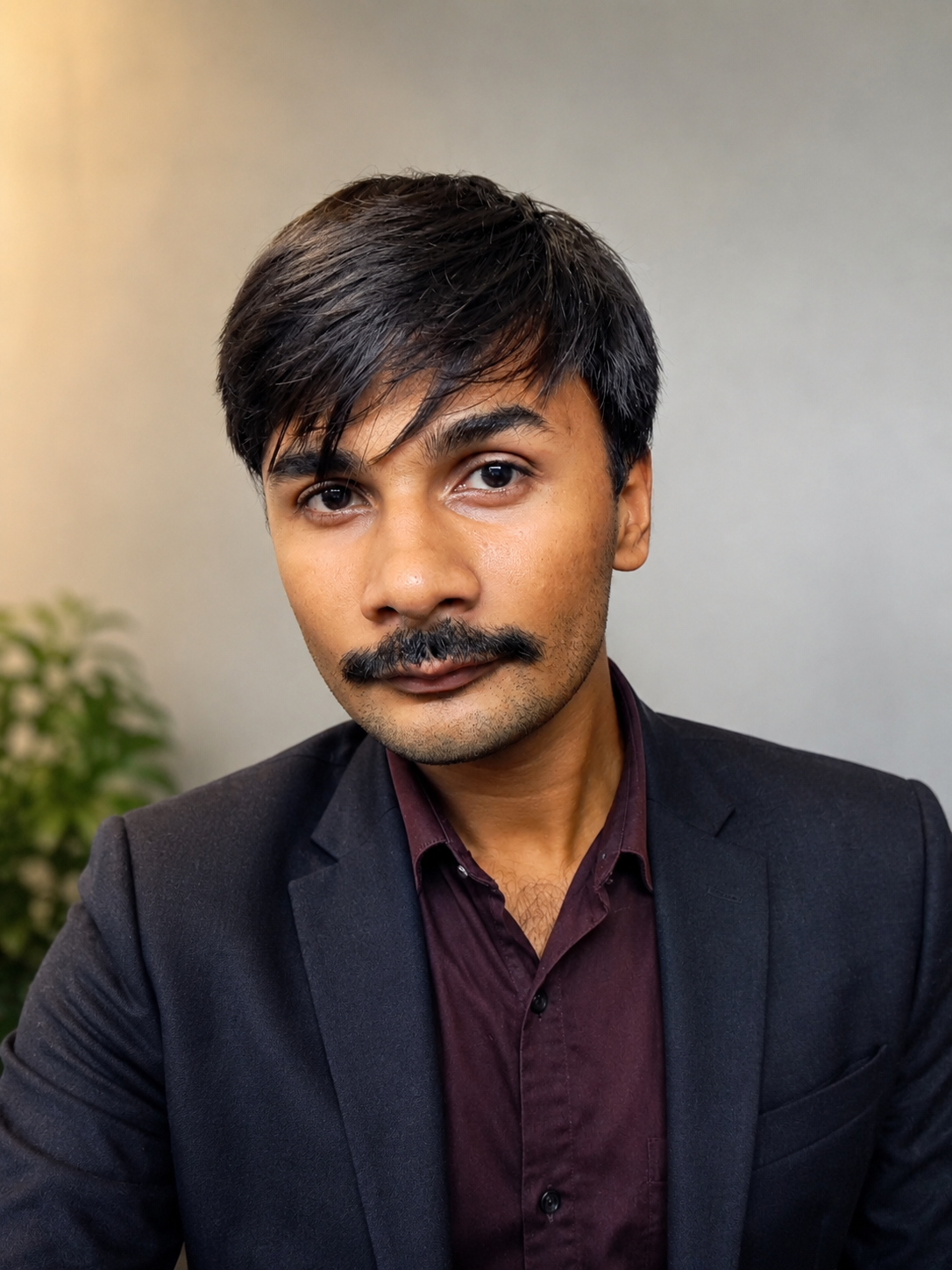
Rudra
Dixit.
Founder, Virya of Virya.
THE FOUNDER
Building businesses, capabilities and systems — not just ideas.
# THE FOUNDER
## Building businesses, capabilities and systems — not just ideas.
Mr. Rudra Dixit is the Founder of Virya, an emerging business group built with a long-term ambition: to develop businesses that are commercially strong, strategically connected and capable of contributing to the growth of India.
At the centre of Rudra's approach is a simple principle: if something needs to change, someone has to take the initiative to build it.
He has little interest in stopping at identifying what is wrong or waiting for someone else to solve it. His instinct is to understand the problem, look for the underlying opportunity and build a practical response. That bias toward initiative shapes the way he approaches entrepreneurship — not as the pursuit of ideas, but as the responsibility to turn useful ideas into functioning businesses.
Rudra is currently studying Behavioural Economics, an area that increasingly influences how he looks at markets and business. He is interested in the mechanics behind human decisions: how incentives alter behaviour, how environments shape choices, why people respond differently to the same proposition, and how those insights can be translated into better products, experiences and business systems.
This has led him to think about a business as more than a transaction.
A business is a system.
It consists of customers, people, incentives, suppliers, capital, processes, infrastructure, information and decisions — all interacting with one another. A weakness in one part can become an opportunity in another. A procurement dependency can become a reason to build an internal capability. A recurring expense can become the basis for a new business. A customer-experience problem can expose a fundamentally better way to deliver the same outcome.
That systems perspective is central to his vision for Virya.
The objective is not to assemble a portfolio of unrelated companies simply for diversification. Rudra wants to build businesses that are relevant to one another — ventures that can supply, serve, strengthen or create capabilities for other businesses within the group.
A distribution network developed by one business may become an advantage for another. A procurement capability may reduce dependency across several ventures. Operational expertise, infrastructure, customers, capital and technology can become shared advantages rather than isolated assets.
The long-term objective is to create a business group whose value comes not only from the individual companies within it, but also from the relationships between them.
This same thinking shapes Rudra's approach to efficiency.
He does not equate efficiency with indiscriminate cost cutting. Cutting expenditure at the expense of customer experience or employee satisfaction may improve a short-term margin while weakening the business itself.
His question is different:
How can the economics be improved without making the experience worse?
Sometimes the answer is vertical integration. Sometimes it is developing a related business, changing procurement, redesigning a process, reorganising resources or finding an entirely different way to deliver the same outcome. Where conventional thinking sees a fixed cost or an unavoidable constraint, Rudra tends to look for a structural solution.
This is where his preference for unconventional problem-solving becomes important. He is less interested in reproducing how an industry traditionally operates and more interested in understanding why it operates that way — and whether it has to.
The objective is not to be unconventional for the sake of being different. It is to find a better economic model while preserving — or improving — the things that actually matter: the customer experience, the quality of the product or service and the people responsible for delivering it.
Rudra's entrepreneurial interests currently span consumer businesses, food, events, construction, infrastructure and other opportunities connected to India's growing economy. He sees this breadth as part of a larger strategy rather than a collection of unrelated interests.
India's next phase of development will require more than consumption. It will require businesses that build, manufacture, engineer, move, supply and support the productive systems on which economic growth depends.
That is why Rudra's long-term ambition extends toward India's industrial and productive capacity.
He wants Virya to participate in India's growth rather than merely benefit from it — by building companies that create employment, develop capabilities, solve practical problems, create products and services, strengthen supply chains and, over time, contribute to the infrastructure and industrial ecosystems that allow other businesses to grow.
But economic contribution, in his view, is not limited to GDP, factories or balance sheets.
Businesses shape the spaces around them.
A business can make a neighbourhood more useful, a workplace more fulfilling, a public-facing environment more active, or an ordinary experience significantly better. It can also do the opposite: extract value while contributing very little to the environment in which it operates.
Rudra wants Virya's businesses to leave their surroundings better than they found them — more useful, more lively, more engaging and more capable of giving people reasons to participate rather than merely survive.
That is why profitability and contribution are not competing objectives in his philosophy.
A business must make money. Profit provides the capital required to employ people, reinvest, experiment, withstand failure and build at a larger scale. But profit is not the final objective. It is the fuel that allows a successful business to build something larger than itself.
Rudra draws inspiration from the idea of Indian business institutions that have grown beyond individual enterprises to become significant contributors to the country's economic development. His ambition is to apply that long-term, multi-sector way of thinking to a new generation of businesses — built progressively, with each venture contributing experience, capability and capital to the next.
He does not expect Virya to become that institution overnight.
A durable business group cannot be manufactured through branding or ambition. It has to be compounded through years of operating businesses, making mistakes, developing people, allocating capital, building capabilities and understanding how different parts of an economy interact.
Virya is the beginning of that process.
The immediate objective is to build businesses that work today. The longer objective is to use what those businesses teach, create and accumulate to build the next ones — gradually developing a network of companies that become stronger because they exist together.
The philosophy is straightforward:
Take the initiative. Understand people. Question the conventional model. Build the capability when the market says you cannot. Improve the economics without compromising the experience. Build businesses that strengthen one another. And use the scale created by business to build something that contributes to the country around it.
Rudra's ambition is not simply to build more companies.
It is to build the capabilities, systems and institutions that make building more companies possible — and, ultimately, to use them to help build India.
Instead of complaining about what India needs, build it.